In this article
A student record can pass through several hands without any one person seeing the whole journey. An instructor prepares a grade, an advisor interprets its effect, a department answers a course question, and another office confirms the official result. Each person may do a reasonable local task while the handoff between them remains vague. That gap is where a saved entry becomes mistaken for a completed action, an informal explanation becomes a promise, or a convenient copy outlives its purpose.
For academic staff searching for utah cis, the useful starting point is therefore larger than a login page. Campus Information Services connects people to university functions; it does not make every visible record appropriate for every employee to use. A careful working method begins by defining the academic job and the person authorized to complete it. The browser comes afterward.
The Academic Operations Review is an independent editorial publication for that working method. It does not operate University of Utah systems, collect student records or reproduce an authenticated dashboard. Its recommendations are preparation aids drawn around public university references. Actual university policies, role approvals, deadlines and instructions remain controlling. A useful plan should make the next official step clearer without pretending to perform it.
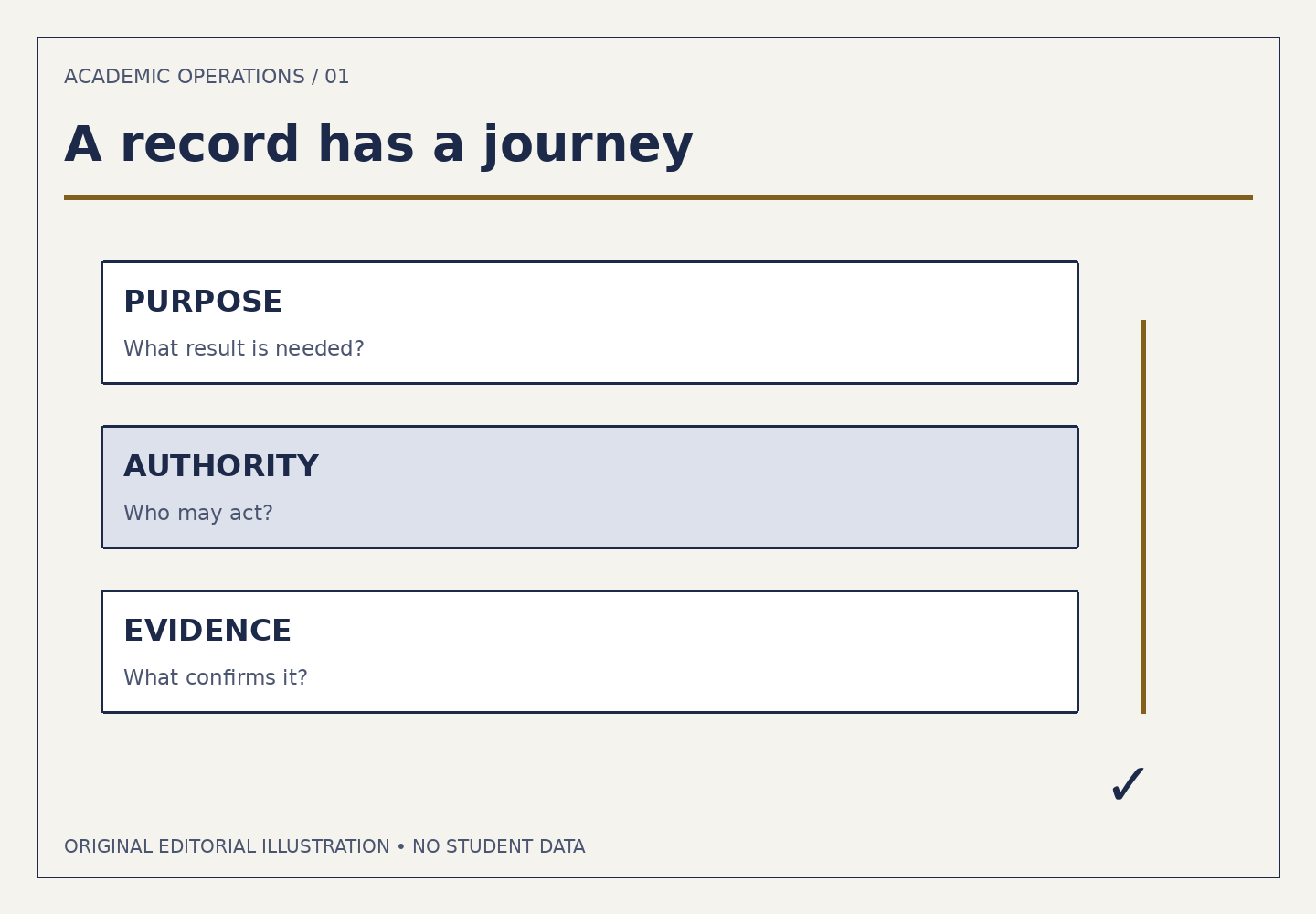
Start with the outcome, not the tile Describe an outcome in a sentence that another colleague could verify. “Check whether the authorized grade submission is complete” is a workable outcome. “Take care of grades” bundles calculation, authorization, posting, exceptions and communication into an invisible package. Similarly, “identify which requirement remains unresolved” is more precise than “fix the audit.” Precision prevents one employee from silently inheriting a decision that belongs to someone else.
Then identify the object of the work. It might be one section, one published scheduling record, one category of discrepancy or one documented process. Keep that object separate from the whole person. A department trying to understand a section-capacity question rarely needs to circulate everything known about the students affected. Begin with the smallest explanation that lets the appropriate colleague recognize the problem.
An outcome should include a boundary. An advisor can prepare a question about a degree requirement without authorizing an exception. A scheduler can gather the academic reasons for a proposed change without promising a room. A teaching assistant can help prepare information without automatically receiving every grading permission. The boundary is useful information, not a sign that the work is incomplete.
Give authority its own line The Registrar’s FERPA Quick Facts states that system access does not permit unrestricted use and connects employee access to a legitimate educational interest. This is a narrow but important factual anchor. Do not infer authority from the presence of a tile, an old role, a colleague’s request or the fact that the person is already known to the department.
In a planning note, distinguish the person doing preparation from the person making the consequential decision. If those roles are the same, say so. If they differ, describe the handoff. Avoid vague labels such as “office” when no actual role is responsible. A request sent to several people may be widely visible and still have no owner.
Current authorization questions belong with the university’s designated process. The Registrar’s Security Access Forms page distinguishes initial authorization, changes and deletion. A department’s editorial checklist is not a substitute for those routes. Nor should staff share credentials or copy restricted records into a new system to compensate for a missing role. A delay that reveals an authorization gap is a problem to resolve through the proper channel.
Separate observation, interpretation and decision An observation is something the authorized person can substantiate: a particular status, a published deadline, a difference between two approved views. An interpretation is what that observation might mean. A decision is the action an authorized person approves after considering the evidence. Combining all three into one sentence makes later review unnecessarily difficult.
Consider the sentence “The student is ready to graduate.” It might mean an advisor expects remaining coursework to satisfy a requirement, a current audit appears complete, or the institution has actually conferred the degree. Those are different claims. A precise note might instead say that an identified requirement appears satisfied in a specified review and that the relevant office must confirm the remaining process. The qualifier is part of the result.
This separation also makes questions easier to answer. Instead of asking a colleague to verify a confident conclusion, describe the exact mismatch and the question it creates. A useful response can then confirm, correct or narrow the interpretation. The record of the exchange stays connected to the real issue rather than expanding into a general discussion of the student.
Name the authoritative place for the result Academic work often has several useful representations. A personal checklist tracks your next action. A course platform supports teaching. An official academic system records institutional outcomes. A public schedule communicates an offering. They can all be useful while serving different purposes. Before acting, identify which place must show the result for the task to be considered complete.
A local spreadsheet should not quietly become the authority because it is easier to read. If it is an approved working aid, label what it represents and when it was prepared. Do not make an inference from an old export when a current authorized source is needed. Conversely, do not repeatedly access a full record when a non-sensitive process status would answer the coordination question.
A good completion statement includes its evidence. “Submitted” may describe an action by the sender; “accepted” or “posted” may describe a different state. Use the terms supported by the relevant official process. If the evidence establishes only an intermediate state, keep the work open and identify the next authorized verification rather than smoothing away the distinction.
Plan the handoff before an absence Continuity depends on more than writing instructions. A replacement needs an approved role, the appropriate training, a bounded task and a way to find the current status in an authorized location. A beautiful guide cannot compensate for missing access, and a working password is never an appropriate handoff mechanism.
Prepare a handoff around decisions still pending. What has already been checked? What remains uncertain? Which deadline matters? Who may approve the next action? A colleague should be able to continue without rereading an entire email history or creating a fresh copy of every supporting record. Where possible, point to an approved source rather than attaching another version.
Also define what the departing employee no longer needs. Continuity and access removal should be considered together. An old responsibility should not remain active merely because nobody has discussed its endpoint. The exact removal process belongs to the university, but the department can make the ownership change explicit and ask that the appropriate review occur.
A fictional department catches a quiet mismatch Imagine an invented department preparing for the end of a term. A faculty member says the grades are finished. The coordinator’s checklist says that every section has a named grader. An advisor is waiting for an academic outcome that depends on one of those sections. All three statements can be true while the final institutional record is still pending.
Rather than asking everyone to email grade sheets, the coordinator defines a narrower task: have the authorized instructor verify the official submission state for the relevant section using current grading guidance. The coordinator records only the process status needed to coordinate the work in an approved location. The advisor is told what is confirmed and what remains pending, without receiving an unnecessary copy of the class roster.
The instructor discovers that preparation and completion had been conflated. The appropriate official action is taken, and the responsible person verifies its result. The coordinator closes the task only after that confirmation. No invented shortcut was required. The improvement came from using a better definition of “finished” and preserving each role’s boundary.
Afterward, the department revises its checklist to ask for verification of the outcome rather than a general assurance. It does not create a new parallel student-record database. The lesson is about the design of coordination: ask for enough evidence to support the next action, without collecting unrelated detail or multiplying sensitive files.
Make exceptions visible without inventing policy A deadline conflict, unusual enrollment situation or unclear requirement deserves a visible question, not an improvised workaround. State the known facts, the requested outcome and the reason the ordinary path appears insufficient. Ask the appropriate office which process applies. Do not promise the student an exception before that authority has decided.
Keep hypothetical planning separate from official records. A discussion about what could happen is useful, but its status should remain obvious. If a team writes a scenario to test a workflow, use invented data and label it. If actual student information is necessary for an authorized case, use the institution’s approved systems and disclosure rules. This publication’s browser-local planner accepts only broad categories precisely because it is not a case-management service.
End with a defensible next step For each task, try five prompts: What result is needed? Who has authority? What source supports the current understanding? What needs to be handed off? What evidence will close the task? If one answer is missing, the plan should show the gap. The aim is not to generate a longer checklist; it is to remove hidden assumptions from a consequential process.
A small, accurate unfinished note is better than a confident claim of completion that nobody can verify. Academic operations work well when the people involved can understand the boundary between preparation and action, and between an expected result and an established one. Speed is valuable after those distinctions are clear. Stewardship is what makes that speed safe to rely on.