In this article
Privacy problems in academic work are often problems of context. A record appropriate for one advisor’s task can become inappropriate when a screen is shared with a different group. A document stored in an approved location can still be exposed to the wrong audience. A helpful example in a training session can reveal a real person’s circumstances when a fictional example would have taught the same lesson.
The University of Utah publishes FERPA resources for faculty and staff, including quick facts and a storage decision guide. This article uses those public resources as a starting point for practical editorial preparation. It is not legal advice or a finding that a particular disclosure is permitted. Individual questions belong with the Registrar and the relevant university privacy or security process.
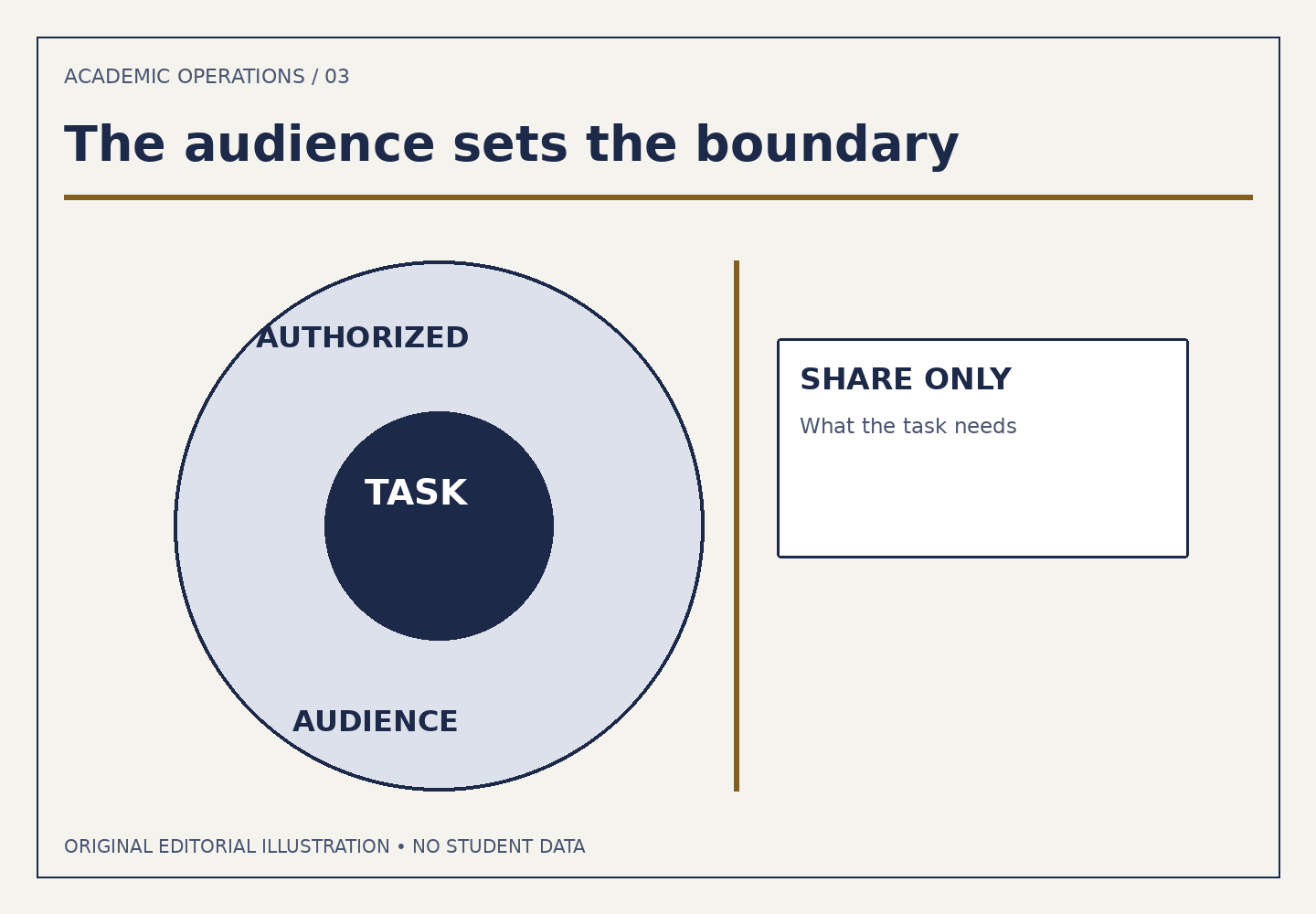
Define the audience before opening the record Begin a meeting by asking what decision needs to be made and who needs to participate. That is easier than opening a full record and trying to remove information while people are watching. The audience should follow the authorized academic purpose. Attendance at a department meeting is not, by itself, an answer to whether every participant needs every record discussed there.
For a process-design discussion, use a fictional case. For an authorized individual case, keep the discussion in the approved setting and use only the details required for that purpose. Do not assume that changing a name alone makes an example anonymous. A distinctive combination of course, event and personal circumstance can still point to a person known to the group.
The Registrar’s quick facts emphasizes legitimate educational interest and warns that curiosity is not a valid reason to inspect student information. That principle should shape the meeting agenda before the technology is chosen. A capable screen-sharing tool cannot resolve a missing reason to disclose.
Make the shared view smaller than your workspace A staff member’s working screen may contain several unrelated cases, notifications or browser tabs. The fact that each is appropriate for the staff member does not mean they are appropriate for the meeting. Before sharing, prepare the narrow view needed for the authorized discussion. Close or hide unrelated material using the institution’s approved practices.
Consider what happens when the meeting changes direction. Someone may ask an unexpected question, another person may join, or a notification may appear. Plan a pause: stop sharing before navigating to a different record or deciding whether a new audience can see it. The pause gives the responsible person time to reassess rather than relying on speed to avoid exposure.
A screen is not the only shared surface. Printed pages, whiteboards, projectors and audible conversations can all carry information beyond the intended audience. Look around the actual workspace. A checklist that mentions only files and passwords can miss the visitor sitting nearby or the document left on a shared printer.
An approved account is only part of the question The university’s public student-data storage guide distinguishes official university-issued accounts from personal accounts and emphasizes authorized viewers. It also says the guide is not comprehensive and directs uncertain cases to the Campus Help Desk or information-security team. Treat that as a reason to check the current arrangement, rather than interpreting a product name as blanket approval for every use.
Ask which account, which configuration and which audience are involved. Two accounts with the same software logo can be governed differently. A link can be restricted to a defined group or open more broadly. A copied file can inherit a new audience. Before sharing an academic record, the relevant permission and storage rules must apply to the actual action, not merely to the software category.
Do not upload student records to public AI tools, independent planning sites or conversion services to make a meeting easier. This journal’s planner uses broad categories and cannot evaluate an individual case. The absence of a login requirement on a website is not evidence that it is a suitable place for institutional information.
Keep coordination notes distinct from case records A team often needs to know that a task is pending, who owns it and when it will be revisited. It may not need the student’s academic history in the same coordination tool. Separate the process status from the underlying record when the approved workflow allows it. A minimal task description can point authorized staff to the proper source without reproducing the case.
Use language that reflects the evidence. “Awaiting the authorized office’s answer” is a process status. A speculative statement about a student’s motivation or circumstances is a different kind of record. Avoid adding guesses to a coordination note simply because they arose in conversation. If the fact is not needed for the task, it may not belong there at all.
When a colleague leaves the role, a handoff should explain where authorized information is kept and what remains open. It should not consist of a personal archive copied to a replacement. Follow university rules for access changes, retention and disposal. This publication deliberately does not prescribe a universal retention period because the applicable rule depends on the record and context.
A fictional meeting redesign Imagine an invented advising team reviewing how to handle a recurring audit question. The first plan is to show several real student records during a large staff meeting. The team pauses and identifies the meeting’s actual purpose: agree on which office should receive which kind of question. No individual decision is being made in that session.
The facilitator creates fictional cases with invented courses and no real student characteristics. Each case contains only the distinction the team needs to discuss. Participants can compare routes, identify ambiguity and improve the handoff without seeing an actual person’s educational record. Any real pending case remains in the approved individual workflow.
Later, a smaller authorized group needs to resolve a real case. The facilitator checks the participants and the official purpose, prepares the relevant view and stops sharing before moving to a different issue. The process-design meeting and the case meeting now have different information boundaries because they have different jobs. The redesign improves both clarity and privacy.
Plan what to do when something goes wrong An accidental disclosure should not be hidden because the recipient is a colleague or because the information was visible only briefly. Follow the university’s current reporting and response process. Preserve the information needed by the responsible team without spreading the exposed material further. Avoid independently promising deletion or resolution that you cannot verify.
For preparation, know where your unit finds current incident-reporting instructions and who can advise on a suspected exposure. That is a useful non-sensitive item for a handoff checklist. Do not create a local incident procedure that conflicts with institutional requirements, and do not use this publication’s contact address to send the affected records.
Review the workflow after the meeting Ask whether each disclosure was necessary for the stated purpose, whether the audience changed, and whether new copies were created. Those questions are more useful than a general statement that everyone “understands privacy.” They reveal concrete places where the next meeting can be better designed.
Privacy-aware work is not simply quieter work. It is work whose purpose, audience and information boundaries are visible to the people responsible for it. A well-designed conversation lets colleagues solve the academic problem without treating every available detail as something that must be shared. The discipline is practical: prepare the right view, pause when the context changes and keep the record where the authorized process expects it.