In this article
The last week of grading is a poor time to discover that several people mean different things by “done.” An instructor may mean that assessment is complete. A colleague may mean that values are entered. An administrator may mean that an official outcome is visible. The department needs a shared definition that respects the academic judgment of the instructor while making procedural completion observable.
This article offers an editorial planning method for faculty and department coordinators. It does not tell anyone what grade to award or replace the University of Utah’s current e-grading instructions. Work in the official system only with the appropriate authority. Never upload a roster or grade file to this publication, its planner or an unrelated service to obtain a procedural answer.
Design the close around sections Begin with the set of sections for which your role has responsibility. For each, establish the applicable term and part of term, the authorized instructor or delegate, and the source of the current deadline. Keep the coordination list free of individual grades when those details are unnecessary. A status question about an entire section can often be answered without copying its student-level content.
Do not infer a deadline from the busiest course in the department. A short session or another academic calendar may need different handling. Open the current grading-calendar resource and confirm the scope before recording a date. A calendar entry is useful only when its term, session and purpose match the work. If they do not match, ask rather than borrowing a convenient date.
Name a backup route for an unexpected absence. That does not mean assigning unofficial permission to a willing colleague. It means knowing who can initiate the authorized delegation or support process. The time to learn that distinction is before the final hour, when a rushed workaround can look deceptively reasonable.
Keep calculation separate from submission A course grade is an academic outcome, and the course’s assessment process should remain distinct from the administrative checklist. A coordinator can ask whether calculation and review are complete without asking to inspect every assessment. Likewise, a technical import is not evidence that the grading scheme or underlying academic judgment is correct.
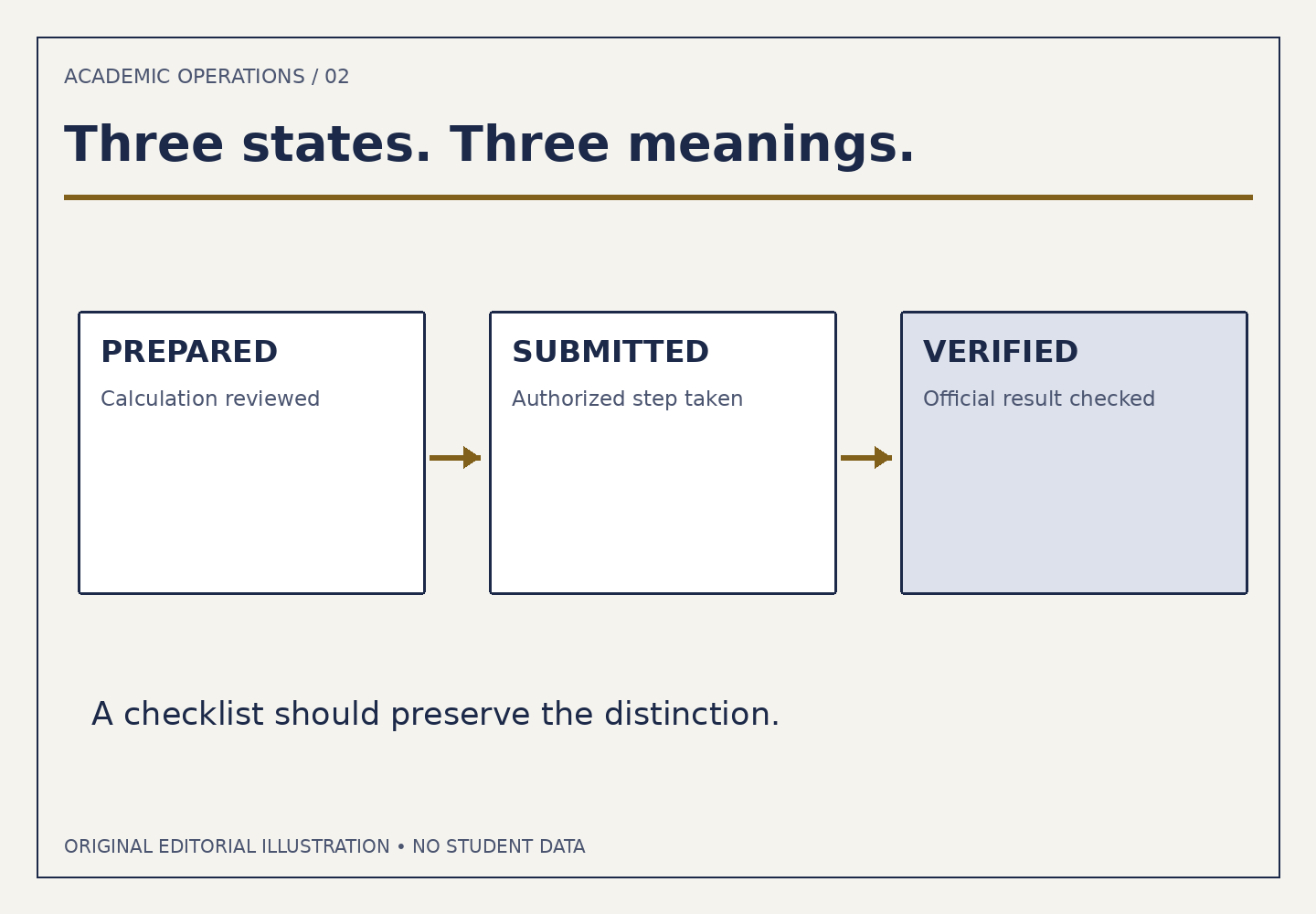
The public e-grading manual distinguishes saving entered grades from posting them to the student record. It also describes importing a final grade associated with a student and class from Canvas. These are distinct operations in the published reference. A prepared value, a saved value and a posted result should therefore never be collapsed into one checkbox. The manual’s dated filename does not establish the layout of every current screen.
Before an authorized submission, the responsible person should use the university’s current instructions to review the relevant class and term. Avoid relying on browser history, an old tab or an export named “final.” File names express intention, not validation. If the expected roster or scope appears wrong, stop and resolve that mismatch through the official support route.
Use a two-person conversation without unnecessary disclosure A useful coordination exchange can be short. The responsible instructor confirms whether the official process is complete for the section and identifies any unresolved procedural issue. The coordinator records the status, the responsible role and the next check. Neither party needs to paste a whole roster into a group thread just to prove that the conversation occurred.
Where a second review is appropriate and authorized, make the review question specific. Is the reviewer checking the scope of the submission, an unresolved procedural flag or the calculation method? Each requires different authority and information. “Please double-check everything” is an invitation to excessive access and ambiguous responsibility. A narrow review is easier to perform and easier to explain later.
Never use another person’s login to make the second review convenient. The Registrar’s public online-grade-posting page describes primary-instructor delegation for class tools or grading access. That published distinction is a reason to use the designated process, not a reason to assume that all delegates receive the same capabilities.
Treat confirmation as a separate task After an authorized action, verify what the relevant official source actually establishes. A success message may relate to a particular step, while the department’s goal concerns the final record. Use the university’s instructions to identify the meaningful completion state. A local checklist should record that state accurately rather than translating every positive message into “finished.”
If the record does not match the intended result, avoid repeatedly submitting the same action without understanding what happened. Preserve the necessary context in an approved location and contact the appropriate office. Describe the section, the step and the observed state through the authorized channel, using only the student information actually needed for that inquiry.
The public grading page also explains that a roster grade and an official grade can differ after a later change. That means a historical view and a current official outcome may answer different questions. Do not “correct” one copy merely to make two views look alike. First establish what each field represents and which process governs the change.
A fictional closeout with three honest states In an invented department, three sections are approaching their grading deadlines. For one, the instructor confirms the official submission is complete. For another, academic assessment is complete but an authorized procedural step remains. For the third, a question about a student’s situation requires the relevant official guidance. The coordinator records three different states instead of marking all three green.
The second section receives an assigned next action and a planned confirmation. The third receives a named owner for the question and an escalation point before the deadline. No one changes a grade solely to clear a reporting indicator. The checklist helps reveal the work; it does not substitute administrative tidiness for academic judgment.
At the next review, the second section can be closed on evidence. The third remains open until its actual issue is resolved. That visibility is valuable even if it is uncomfortable. A dashboard that hides uncertainty gives the department less control than a short list that accurately distinguishes completed work from pending decisions.
Prepare for corrections without rewriting history A later correction should follow the university’s current grade-change process. Keep the fact that a correction is pending separate from the original submission’s completion. A department can accurately say that the original submission was verified while also recording an unresolved later change. Those statements describe different events.
Avoid creating an unofficial promise about when a change will appear. Acknowledge the step that has actually occurred and identify who can confirm the next one. If a student asks for a consequential assurance, route the question to the responsible office rather than extrapolating from an internal planning note.
For future terms, evaluate the process using non-sensitive lessons. Which sections lacked a backup? Which reminders were tied to the wrong session? Which completion term caused confusion? Those observations can improve the next close without retaining unnecessary grade details in the review document. The best end-of-term checklist is a compact record of responsibility, current state and evidence, with room for an honest unresolved question.