In this article
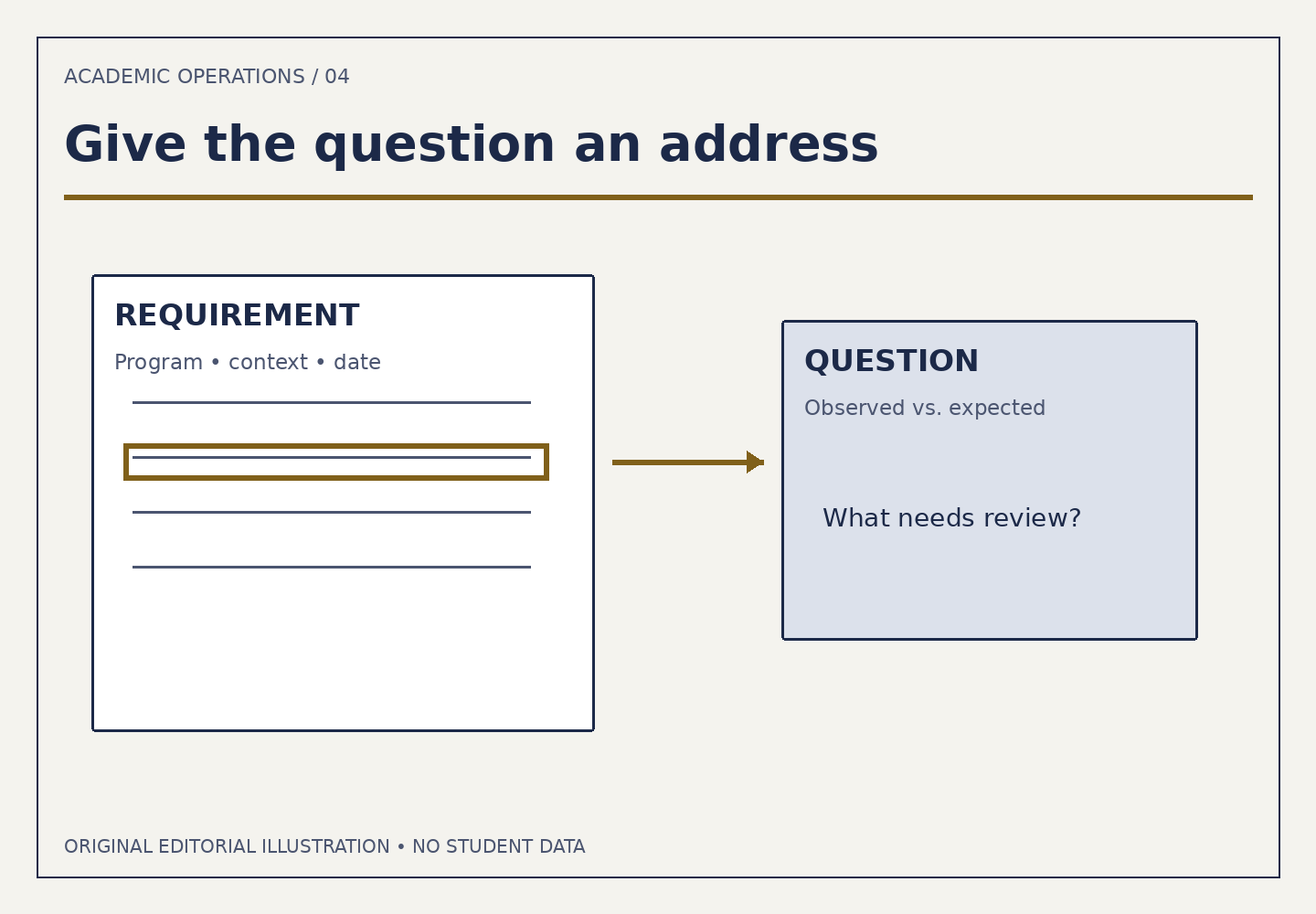
An audit discrepancy is easiest to discuss when it has an address. “The audit is wrong” asks the recipient to reconstruct an entire academic story. “This requirement appears unresolved, and this course is the reason we expected a different result” gives an authorized advisor a specific relationship to investigate. The second statement is not a verdict. It is a better question.
For academic advisors and department staff, the goal is to preserve that distinction while helping the student understand what happens next. A degree audit is a useful representation of academic progress, but a local interpretation should not become an unsupported guarantee about completion, substitution or graduation. This article presents a preparation framework rather than instructions for changing a student’s record.
Establish what was actually reviewed Record the audit’s purpose and relevant program context in the approved advising workflow. A declared-program review and an exploratory scenario are not interchangeable. The university’s public Degree Audits page distinguishes declared audits from what-if audits. That difference matters before a staff member compares the result with a student’s expectation.
Next identify the relevant catalog context and the time of the review. A copied result may reflect a different set of assumptions from the current conversation. Avoid diagnosing the discrepancy from a cropped screenshot that hides its scope. If more context is needed, obtain it through the authorized process rather than asking the student to upload a full academic record to an independent website.
Ask what decision depends on the answer. Is the student planning a later course, asking whether prior work applies, or preparing for an upcoming completion review? The same visible discrepancy can have different urgency depending on the decision. Make that urgency explicit without presenting it as evidence that the desired interpretation must be correct.
Give the requirement a precise address Locate the exact requirement or subsection at issue. A course can appear somewhere in an academic record without satisfying the particular requirement under discussion. The useful question concerns the relationship between the course and the requirement, not merely whether the course is visible anywhere.
In an approved note, distinguish the observed display from the expected outcome. For example, an authorized advisor might record that a requirement remains unresolved and that the student expected a certain course to apply. That formulation leaves room for several explanations: the expectation, the record, the program context or the interpretation may need review. Do not choose among them before the responsible person has evidence.
Keep neighboring requirements in view when they affect the question, but do not widen the investigation without a reason. A narrow question can become difficult to answer if the packet includes every academic document the student has ever supplied. The recipient needs enough context to assess the relationship, not a burden of irrelevant material.
Separate three kinds of uncertainty One uncertainty concerns the record: is the relevant academic information present and accurate? Another concerns the rule: which requirement applies in this program context? A third concerns interpretation: how does the recorded work relate to the rule? Labeling the uncertainty helps identify who should answer it.
An advisor should not use an exception as the first response to every unclear result. A missing or misunderstood piece of evidence might require a different process. Equally, a documented academic decision might need an authorized exception workflow before the audit reflects it. The right next step depends on which kind of issue has been established.
The Degree Audits page directs transfer-course questions to different advising roles depending on whether the issue concerns general education and bachelor’s requirements or the major. Use that public distinction to locate the appropriate expertise. It does not mean that any one advisor can authorize every change or that a transfer course will necessarily receive the treatment requested.
Design a question the recipient can answer A focused inquiry has four parts: the requirement being examined, the relevant observed evidence, the expected relationship and the decision needed. It should be clear whether you are asking for an explanation, a correction or an authorized academic review. Those requests may follow different routes.
Avoid loaded wording such as “Please fix this obvious error.” It assigns a cause before the evidence has been reviewed. A more useful approach asks whether the recorded course is being evaluated under the intended requirement and what official step applies if it is not. The question can be firm about urgency while remaining open about diagnosis.
Use the approved channel for actual case information. A public-source article can explain the structure of the inquiry, but it cannot receive or decide the case. If an official office requests a specific document or screenshot, follow that office’s secure instructions and avoid including unrelated records.
A fictional advising conversation Imagine an invented student who believes a completed course should satisfy an elective requirement. During an authorized advising meeting, the advisor notices that the conversation refers to one program scenario while the displayed audit represents another. The first correction is to the comparison, not to the student’s record.
After reviewing the appropriate context, one question remains: how should a particular piece of prior work be evaluated? The advisor identifies the responsible academic role and prepares a bounded inquiry. The student is told what was clarified, what remains unresolved and which decision is pending. No promise is made that the course will count simply because the question has been forwarded.
When the answer arrives, the advisor checks whether it explains the issue or authorizes a further step. If a formal process is needed, that process is tracked separately. The meeting note does not turn an academic recommendation into a completed exception. The next review checks the relevant official result rather than relying on the memory that “someone said it was fine.”
Close the communication loop with the student Students should not have to interpret internal workflow language without context. Explain what the next step means in ordinary terms: a question is under review, a decision has been made, an authorized action is pending, or the result has been verified. Keep those states separate. Clarity about uncertainty is more helpful than a vague reassurance that everything is being handled.
If the answer affects a near-term choice, tell the student where that choice should be discussed. Do not extrapolate from a single requirement to an entire academic plan. A resolved discrepancy may remove one obstacle while leaving other requirements or processes unchanged. The scope of the confirmation should match the scope of the evidence.
Finally, keep the useful institutional lesson. If the same requirement repeatedly creates confusion, raise the pattern through the proper curriculum or audit-maintenance process using appropriate information boundaries. An individual case should not silently become a general rule. The best advising question resolves the immediate uncertainty and leaves a clearer path for the next person who encounters it.