In this article
A class schedule is more than an inventory of offerings. Students use it to arrange work, care, travel and academic progress. Faculty use it to plan teaching. Departments use it to coordinate rooms, staffing and related courses. A small inconsistency can therefore travel far beyond the person who first entered or reviewed the information.
For department schedulers, the useful question is not only whether a change was submitted. It is whether the published offering accurately represents the authorized academic plan at the point students will rely on it. This article offers an editorial review framework around the University of Utah’s public scheduling guidance. It does not replace the current CLSS process, approve a change or determine room allocation.
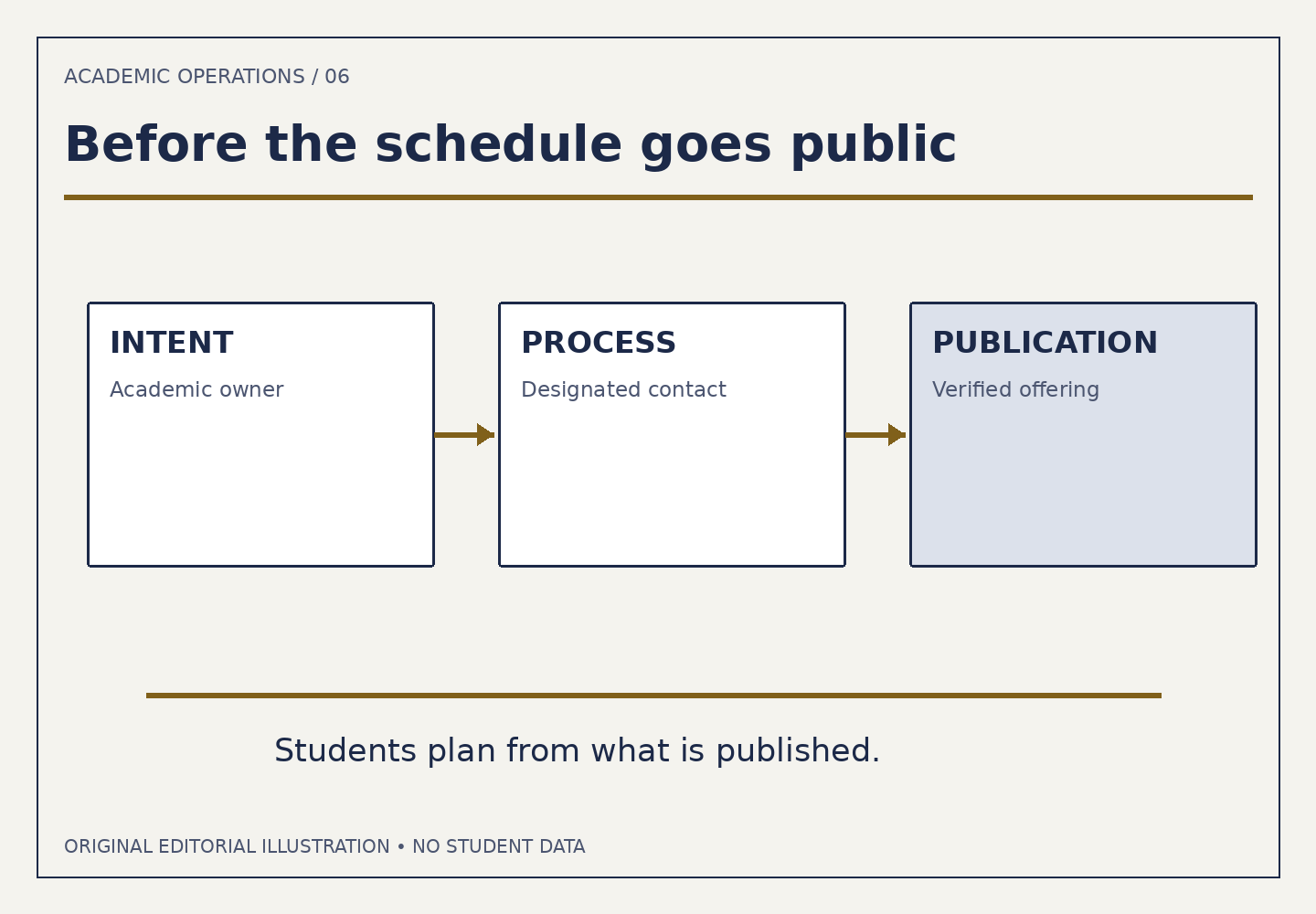
Review the offering as a student will encounter it Start with the public representation. What will a student understand about the section’s timing, format and conditions? Are the visible details consistent with the department’s authorized intention? The reviewer should not need private background knowledge to interpret a basic public statement correctly.
Then distinguish a factual discrepancy from a proposed academic change. A typo correction and a request to alter the offering may have different consequences and routes. If staff treat both as “quick edits,” they can skip the important question of who must approve the change and whether the current phase permits it.
Use a review note that describes the issue, its effect and the requested outcome. “Update section” is too broad to guide careful work. A specific note lets the designated scheduler understand whether the department is correcting a mismatch, proposing a change or asking for clarification about the current record.
Use the designated-contact model The Registrar’s New Scheduler Onboarding page says class changes are accepted from designated contacts with CLSS access, and faculty should route requests through their department contact. It recommends at least two contacts per department. These public instructions support a practical continuity model: responsibility should be clear and should not depend on one person being continuously available.
The department can prepare a request before the scheduler acts. Faculty can explain the academic need; a chair can provide the relevant decision; staff can identify affected public information. But preparation does not replace the designated submission route. A parallel email sent to several offices can create confusion about which request is authoritative.
Keep the backup arrangement current. An old name in a handbook is not enough if the person’s role has changed. The unit should know who is responsible today, what scope they cover and how a pending request is handed over. No shared credentials or copied personal archives are needed to make that ownership explicit.
Read the phase before choosing the action The university’s scheduling-deadlines page organizes work by term and phase, including preparation, room assignment, review and publication, and enrollment. It also identifies limits on major late changes. The planning implication is that a technically possible edit may still need a particular institutional process. Check the current term-specific guidance rather than assuming that last cycle’s timing applies.
An internal review date should come before the official deadline when possible, but label it honestly. Staff should know which date is a department target and which is an institutional cutoff. Confusing the two can either create unnecessary urgency or leave too little time for the actual approval sequence.
If the desired change is outside the ordinary window, state that fact in the inquiry. Explain the academic need and the consequences of leaving the record unchanged. Ask which authorized process applies. Do not alter another field as a workaround or present a tentative arrangement to students as though it were already approved.
Separate the change from its communication A change request and a communication plan are related tasks. Even when a change is authorized, students and instructors may still need clear information through the appropriate university channels. Conversely, announcing a proposed change does not make it official. Track those tasks separately so one is not mistaken for the other.
Define who is responsible for the communication and what fact has been confirmed. Avoid sending an announcement based on a local draft alone. The wording should match the established state of the offering. If a decision is pending, that uncertainty belongs in the message rather than being hidden behind a confident future tense.
Do not gather student contact information into an unapproved tool just to simplify outreach. Use the institution’s approved communication methods and the permissions associated with the actual purpose. The schedule-review packet should not become a new student-record collection.
A fictional late request with an honest route An invented department notices that the public description of a section does not match what the instructor expected. The initial suggestion is to tell students informally and “fix the system later.” The scheduler instead separates the factual question from the proposed change: which details were actually authorized, and what change is now being requested?
The appropriate academic role clarifies the intended outcome. The designated scheduler checks the current phase and routes the request through the official process. Meanwhile, the department prepares a communication that does not promise an unapproved result. The students’ planning needs are considered without treating urgency as permission to bypass the established route.
After the authorized result is visible in the relevant official source, the responsible person verifies it and completes the approved communication. The department closes both tasks only when their distinct outcomes are established. A submitted request, a published record and a sent notice are no longer treated as a single event.
Review dependencies before declaring success A section can be connected to other offerings, staffing arrangements and academic plans. Ask which dependencies the change affects and who can evaluate them. The answer may require a conversation across units rather than another field in a local checklist. Do not assume that the person entering the change is also authorized to settle every related academic consequence.
When a dependency is uncertain, record the question and its owner. “Someone should check the related lab” is not a completed handoff. A bounded responsibility is more useful: identify the relevant role and the specific relationship that needs confirmation. Keep actual student information out unless it is necessary and authorized for that review.
The final verification should examine the public-facing result as well as the internal process state. That does not mean inventing an independent source of truth. It means checking that the official published representation now reflects the authorized outcome the department intended.
Build a better next-cycle review After the cycle, examine the issues that caused rework. Were requests missing an academic rationale? Did reviewers use an old term? Did a public note assume students knew an internal abbreviation? Did backup ownership fail during an absence? These are useful process questions that do not require exposing individual student records.
Turn each recurring problem into a targeted improvement. A short request template can clarify the decision and desired result. A source link can prevent reuse of an outdated deadline. A pre-publication review can catch ambiguity before students build plans around it. Avoid growing a checklist indefinitely when a clearer ownership rule would solve the problem.
Treating the schedule as a public promise does not mean guaranteeing that circumstances never change. It means respecting the consequences of what is published and making changes through a careful, visible process. Accuracy, authority and communication belong together because the people relying on the schedule experience them as one academic offering.