In this article
A visible empty seat feels like a simple fact. A student sees availability, a faculty member wants to help, and a department wants to avoid turning someone away unnecessarily. Yet the relevant question may not be whether any seat is empty. It may be whether that seat is available to the population the student belongs to at that point in the registration cycle.
The University of Utah’s public Reserve Capacity Registration page describes a Fall 2026 pilot for selected courses. It explains that seats can be reserved for populations defined by such factors as major, minor, class level or student group. Sections may have multiple requirement groups. This article uses that bounded public context to propose a communication and planning method for departments; it does not determine eligibility or allocate seats.
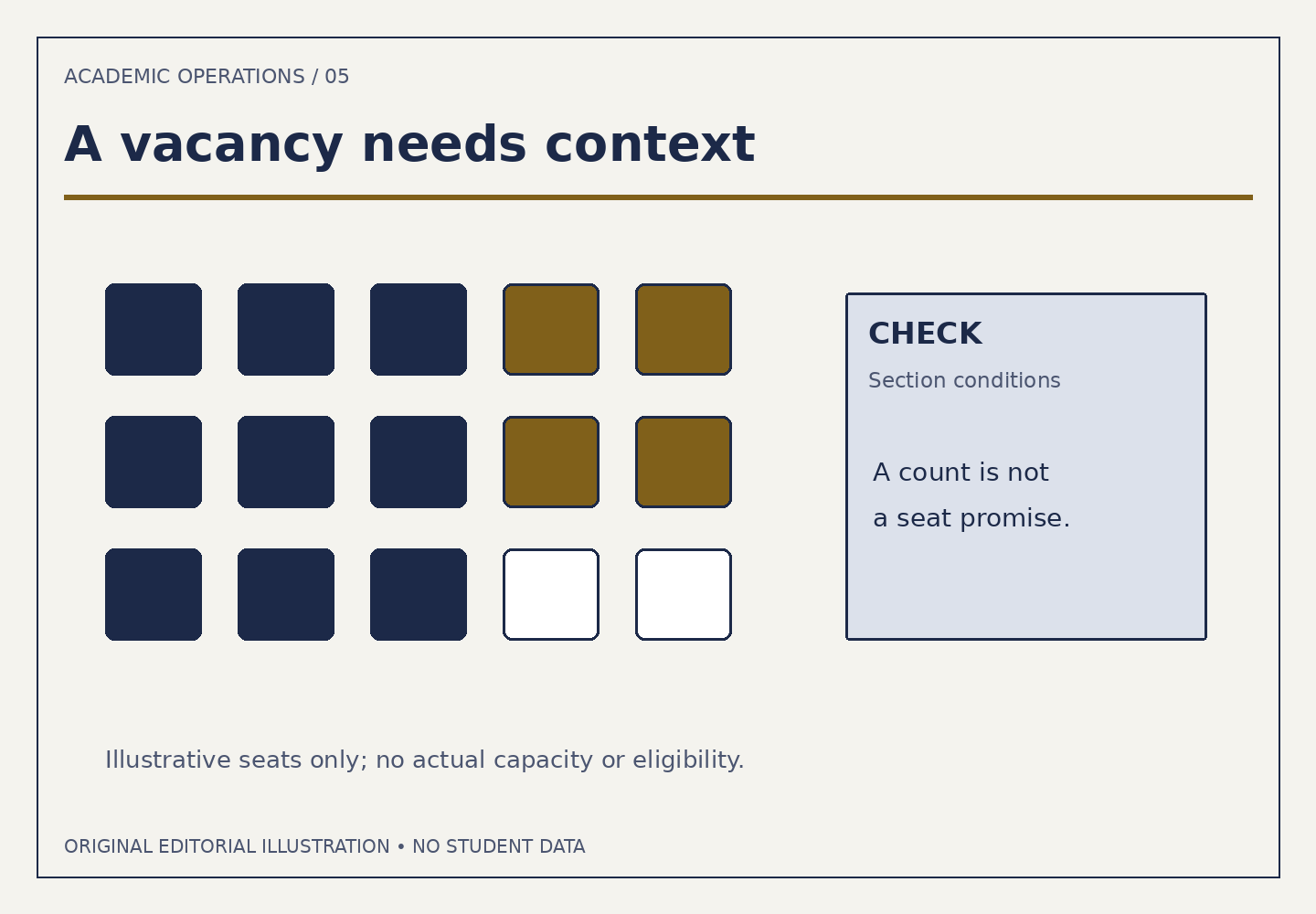
Read the pilot as a pilot A pilot should not be described as universal functionality. At the source review on October 15, 2026, the page described later direct setup in CLSS as a future rollout stage. It directed departments interested in Spring 2027 or later use to contact Scheduling for a scoping meeting. Do not convert that future description into instructions claiming every scheduler can configure the feature now.
Keep a date on local explanations of the pilot. As a service develops, a previously accurate planning note can become incomplete. The official page is the place to verify current scope, criteria and process. A department should not rely on an independent article to decide which populations have reserved seats in an actual section.
The immediate editorial lesson is simple: state what is known about the specific offering and what still needs an authorized check. A general announcement about a pilot does not establish that a given section participates or that a particular student meets the relevant criteria.
Separate three different questions First, what does the published section information say? Second, what is the authorized interpretation of the reserve conditions for that section? Third, what does the student’s actual situation establish under those conditions? These questions may require different sources and different people.
A public seat count can help identify a question without answering all three. Staff should avoid reading a count as a promise. An advisor may need to verify the population criteria through the appropriate authorized route. A scheduling question may concern how the department’s intended offering is represented, rather than whether a student should be given an exception.
This separation helps the student receive a useful answer. Instead of saying that the system is behaving unpredictably, describe which part is still being checked. If the issue concerns reserved capacity, say that an apparent vacancy alone does not settle the question. Do not speculate about another student’s eligibility to explain what happened.
Explain waiting without discussing other students The official reserve-capacity page says that a student can remain on the waiting list despite a vacancy if the available place is reserved for a population they do not meet. It also explains that a later-positioned eligible student may enter a reserved place. Those narrow facts can explain the mechanism without revealing anybody else’s academic information.
A department should not use a public queue position as a complete forecast. The appropriate next step is to check current criteria and the official process, not to promise that the next vacancy must go to a particular person. The exact outcome remains subject to the university’s rules and current data.
When a student is frustrated, distinguish empathy from a guarantee. It is reasonable to acknowledge that a visible vacancy can be confusing. It is not reasonable to invent a workaround or claim that staff can rearrange eligibility. A precise explanation protects the student from planning around a seat that has not been established.
Prepare a department scoping conversation If the department is considering reserve capacity for a future offering, begin with the academic purpose. Which population needs access, and why? What problem is the proposed arrangement intended to solve? How will the department communicate its meaning clearly? These are planning questions for the official scoping conversation, not a local authorization to create a new rule.
Identify dependencies without proposing unsupported technical settings. The course may serve more than one program, and a change can affect advising expectations elsewhere. Invite the appropriate academic roles to clarify the purpose before presenting a technical solution as decided. The design should reflect an authorized academic rationale, not merely an attempt to make the enrollment count look preferable.
Prepare examples with invented populations and counts when discussing the concept broadly. Real student records are unnecessary for explaining how the department hopes the arrangement will work. The official team can specify what actual information is needed later and through which approved channel.
A fictional vacancy that needs a better explanation Imagine an invented course whose public listing appears to show an available seat. A student asks an instructor to confirm that they can enroll. The instructor avoids treating the visible count as the entire answer and sends the question to the appropriate departmental role.
The authorized review establishes that the section has a reserved-capacity arrangement relevant to the inquiry. The student receives an explanation of the applicable process and where to obtain a current answer about their own situation. Nobody identifies another student or describes that person’s academic status to justify the result.
The department also notices that its public explanation is too vague. It prepares a clearer description for the appropriate approval process, distinguishing a general availability signal from an enrollment guarantee. The immediate student inquiry and the broader communication improvement are tracked as separate tasks, each with its own owner and finish.
Do not turn historical behavior into a forecast A prior term can provide useful context, but it should not establish the next term’s criteria or release timing. The current official arrangement controls. A department’s memory that seats “usually open up” is not a reliable commitment to an individual student, especially while a feature is being piloted or expanded.
For planning, record uncertainty explicitly. A student may need an alternative academic discussion if the desired seat remains unconfirmed. Staff can help identify the appropriate advising route without assuring a particular outcome. The distinction is practical: planning for uncertainty is different from declaring that the preferred result will occur.
Likewise, an instructor’s willingness to teach another student should not be treated as evidence that every institutional condition has been resolved. Capacity, academic criteria and the official enrollment process can involve different authorities. Keep those questions separate until the appropriate people have answered them.
Evaluate the explanation after the cycle A useful department review asks whether students understood the public description, whether staff knew who could interpret the criteria, and whether questions reached the right office. It does not require a broadly shared list of students who did or did not qualify. Use the approved evidence appropriate to the review’s purpose.
Look for ambiguous phrases in standard messages. “There is space” can sound like a guarantee even when the staff member intends only to describe a count. “You are next” can imply a prediction that the relevant conditions do not support. A better message names the confirmed fact and the unresolved condition separately.
Reserved capacity makes an old communication lesson more visible: a number needs context. Departments serve students best when they explain the current process clearly, keep individual records within authorized boundaries and refuse to promise what a public count alone cannot establish.